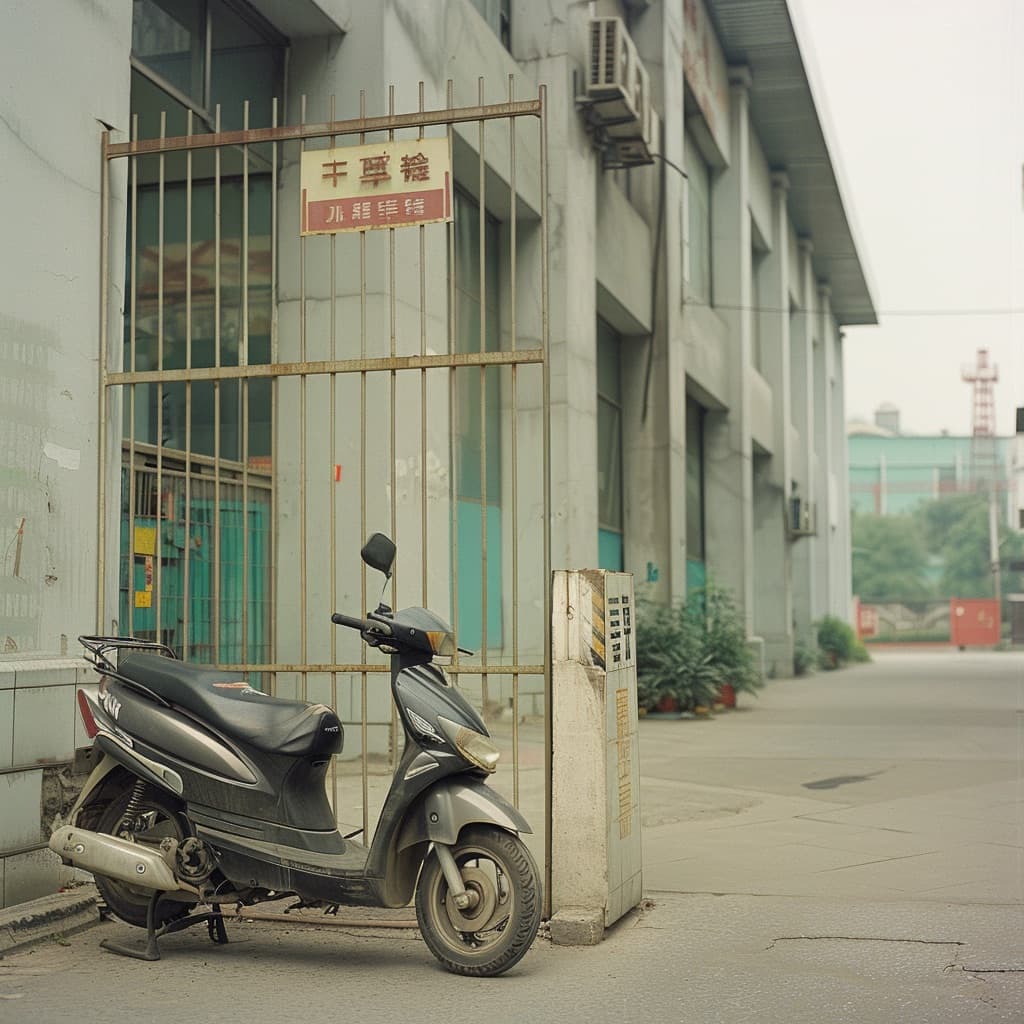
Backstage since 2006. Scooters, not suits.
PWI started in 2006 with two people and a scooter in southern China.
Our founder, Drake, and our first colleague, Thomas, spent their days riding from factory to factory to find the right products for a business friend in Russia. No driver, no glossy office – just a scooter, a list of factories and a promise to deliver.
“Once we were stopped at a gate because we arrived on a scooter. In front of the building there was a huge sign saying ‘Welcome! Drake from PWI.’ The guard assumed we couldn’t possibly be the guests on the board.”
That little scene sums up PWI quite well: we care far more about what actually leaves the factory than how impressive we look arriving there.
Backstage for brands you’ve actually heard of
Since then, we’ve quietly sat in the background of projects for global names like Tonino Lamborghini, Thomson and Muhammad Ali, sector leaders like Ekster and Hiper, and many niche and emerging brands. Most of those products went into the world wearing someone else’s logo. That’s exactly how it’s supposed to be. Our place is in the engine room of the supply chain, not on the box.
We’ve also worked with start-ups and small brands – including early foldable shopping bag ventures and independent labels like Miss, 9cm zoo, Echoing Green and others. Not all of them survived. Good design and a strong brand idea aren’t always enough. Timing, funding, marketing and more matter. When the supply chain is looked after properly, founders at least get a fair shot to focus on product–market fit, marketing and community.
From IPO to hands-on partner
Early years: acting as an International Purchasing Office. Then an international sales office. Eventually an international business partner, taking on more day-to-day supply chain work. Projects spanned tech gadgets and electronics, fashionable accessories, gadgets and toys, textiles, leather goods, bags, perfume and other consumer items.
What that taught us: there is no one-size-fits-all supply chain; a beautiful idea can be destroyed by bad execution; and a good supply chain can’t rescue a product nobody wants. We can’t write your brand story or run your campaigns. We can lift the supply chain load so you can focus on the parts only you can do.
London, circular economy, and seeing the gap
In 2019 Drake moved to London. Living in Europe put circular economy thinking in front of us daily, while we stayed connected to factories and material clusters in China and Taiwan. The contrast was clear: Europe’s sustainability mindset is broad and demanding; in China it is often defined narrowly by client specs and compliance lists. Parts of a truly sustainable supply chain exist, but the chain isn’t fully joined up.
Many factories weren’t deliberately greenwashing; they were responding to simplified briefs. Some of the best suppliers are small workshops that invest in practice over certifications. We’re bridging these worlds because we understand both the European sustainability mindset and the Asian manufacturing reality.
From make–use–ditch to make–use–regenerate/remake
As PWI approached its 20-year mark, we committed: every new product development must aim for our definition of a sustainable product. We focus on products that are made from 100% natural materials that can safely return to nature, or made from 100% endlessly recyclable materials designed for real-world recycling, or repairable products built from separable parts.
The full chain for this kind of product isn’t always built yet. “Eco” is still a label more than a design principle in many factories. We’re committing our supply chain expertise, relationships and time to building honest, workable sustainable product supply chains one project at a time—with clients who care about truth as much as growth.
How we work now: sleeves rolled up, skin in the game
- Partners, not introducers. We don’t just send a list of factories. We stay in, mediating between your vision and the factory’s reality from idea through production.
- Operators, not deck-writers. We handle the communication, awkward questions, and the small technical decisions that add up.
- Industrial common sense. Hundreds of projects give us a feel for what will break in the wild and what will quietly destroy margins.
- Paid on production. We agree a percentage on top of factory invoices and only bill when production is happening. No big retainers; fits crowdfunding, pre-orders and staged launches.
Our role is simple to describe and hard to do well: take the weight of building and running a supply chain in Asia off your shoulders—especially when you’re in a start-up phase with sustainable products—so you can focus on building a brand that deserves that supply chain. No slogans. No perfect stories. Just practical, hands-on work to help you move from make–use–ditch towards make–use–regenerate/remake.